
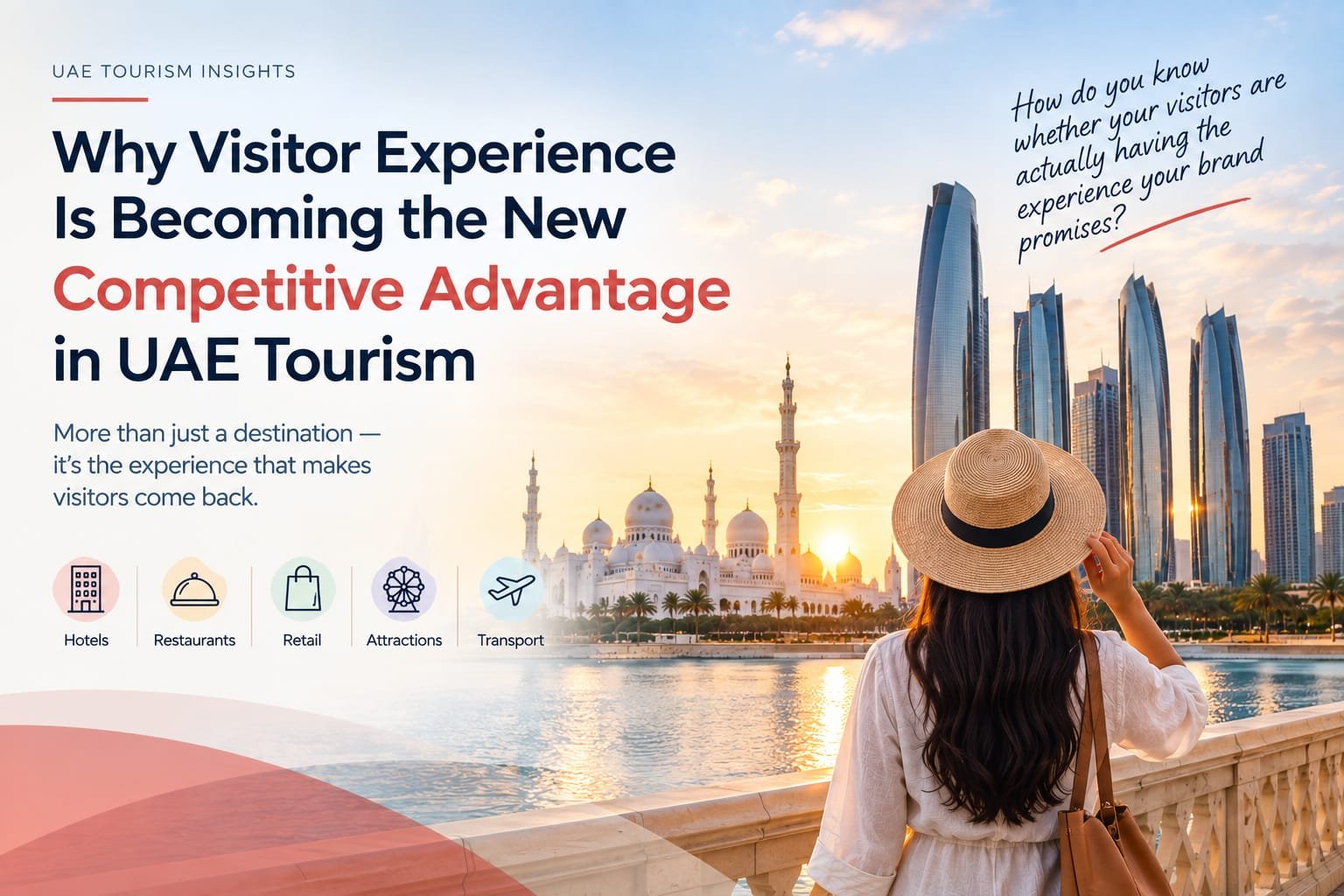
Why Visitor Experience Is Becoming the New Competitive Advantage in UAE Tourism
What makes a visitor choose one destination, hotel, attraction or experience over another?
The answer is not always price.
It is not always location.
And it is not always the product itself.
Increasingly, it comes down to experience.
The UAE has built a strong reputation as a global tourism destination, with visitors coming for its hotels, attractions, shopping, culture, dining and events. As competition within the tourism sector grows, simply offering a good product may no longer be enough.
The experience surrounding that product matters just as much.
This has become even more relevant with the launch of Abu Dhabi’s first Visitor Experience Awards by the Department of Culture and Tourism – Abu Dhabi. More than 400 tourism and cultural organisations have been invited to participate, with the programme recognising both businesses and frontline professionals that contribute to high-quality visitor experiences.
The message is clear:
Visitor experience is no longer just something businesses talk about. It is becoming something they actively measure, improve and compete on.
But What Does “Visitor Experience” Actually Mean?
Visitor experience is much bigger than whether someone enjoyed a particular attraction.
Think about a tourist visiting Abu Dhabi for the first time.
Their experience may begin before they even arrive.
They might search online, ask a question through WhatsApp, book tickets, arrange transportation and look for information about what to do.
Once they arrive, the experience continues through the airport, hotel, restaurant, attraction, shopping destination and other interactions.
At each stage, the visitor is forming an impression.
Was the information easy to find?
Was the booking process simple?
Were employees helpful?
Did staff know the answers to questions?
Was the destination easy to navigate?
Did the service feel welcoming?
Was a problem handled well?
These individual moments eventually become one overall impression of the business — and sometimes of the destination itself.
Why Are UAE Tourism Businesses Paying More Attention to Experience?
The UAE tourism sector is highly competitive.
Visitors have many options, and expectations are high.
A hotel is competing not only with another hotel. A restaurant is competing not only with restaurants nearby. Attractions, retailers and cultural destinations are all part of the visitor’s overall journey.
A visitor can have an excellent experience at one touchpoint and a disappointing one at another.
For example, an attraction may have an impressive facility and excellent exhibits, but if visitors struggle to find the entrance, wait too long for assistance or receive inconsistent information from staff, the overall experience can be affected.
The physical product may be excellent.
The experience can still fall short.
The Question Businesses Should Be Asking
This leads to an important question:
How do you know whether your visitors are actually experiencing the service you designed for them?
Most businesses have standards.
They may have customer service guidelines, employee training, operating procedures and brand expectations.
But having a standard and consistently delivering it are two different things.
Management may believe that employees are following the expected process.
The customer may experience something completely different.
That gap is where experience measurement becomes important.
Mystery Shopping: Seeing the Experience From the Visitor’s Side
Mystery shopping gives businesses an opportunity to experience their own customer journey from the outside.
Instead of relying entirely on internal reports or asking employees whether a process is being followed, an independent evaluator experiences the journey as a real visitor.
The evaluation can be designed around the business’s actual priorities.
For a hotel, that could include:
– Pre-arrival communication
– Booking experience
– Check-in
– Staff interaction
– Room presentation
– Dining experience
– Concierge service
– Complaint handling
– Check-out
For an attraction or cultural destination, it could include:
– Ease of finding information
– Ticketing
– Arrival and welcome
– Staff knowledge
– Accessibility
– Wayfinding
– Cleanliness
– Engagement
– Overall visitor journey
For a retail business, the focus might be:
– Greeting
– Product knowledge
– Needs identification
– Personalisation
– Store presentation
– Purchase experience
– After-sales service
The point isn’t to create a generic checklist.
It is to measure the moments that matter to that particular visitor journey.
A Good Experience Audit Goes Beyond a Score
A score can tell a business that something happened.
It doesn’t always explain why.
Suppose a visitor rates a staff interaction poorly.
The important question is not simply:
“Why did we lose points?”
It is:
“What happened during that interaction?”
Was the employee missing information?
Was the process unclear?
Was the team too busy?
Was training insufficient?
Was the customer journey itself poorly designed?
This is where detailed experience audits become valuable.
The aim should be to move from finding problems to understanding them.
Frontline Employees Are Part of the Experience
The Abu Dhabi Visitor Experience Awards are also recognising frontline professionals, not just organisations.
That is significant.
A visitor may remember the architecture of a destination.
They may remember the food.
They may remember the view.
But they can also remember the employee who went out of their way to help them.
The receptionist who solved a problem.
The restaurant employee who made a recommendation.
The retail associate who understood what the customer needed.
The attraction guide who made the visit more interesting.
These interactions can turn an ordinary visit into a memorable one.
That is why measuring frontline performance should not only be about compliance.
It should also consider how the interaction makes the visitor feel.
Consistency Is Where the Real Challenge Begins
One great employee can create an excellent experience.
But businesses cannot build a sustainable reputation around individual employees alone.
The experience needs to be consistent.
A visitor should ideally receive the same standard whether they interact with:
– Employee A or Employee B
– Branch A or Branch B
– A weekday team or a weekend team
– A quiet shift or a busy shift
This is particularly important for businesses with multiple locations or high visitor volumes.
Experience measurement can help identify whether the service standard is actually consistent across those different touchpoints.
What Happens When You Don’t Measure?
The biggest risk is not necessarily receiving a bad review.
It is not knowing where the experience is breaking down.
Customers do not always complain.
Some simply don’t return.
Others choose a competitor next time.
Some share their experience privately rather than directly with the business.
By the time management notices a pattern through reviews or customer feedback, the underlying issue may have been happening for months.
Regular customer experience measurement provides an opportunity to identify these gaps earlier.
From Visitor Feedback to Business Improvement
The purpose of measuring visitor experience should ultimately be improvement.
A useful process might look like:
Measure → Understand → Improve → Re-measure
For example, if visitors consistently report difficulty finding information, the business can investigate the cause.
If staff knowledge varies between locations, training may need to be reviewed.
If customers experience long waiting times, the business may need to examine staffing or workflow.
If a particular stage of the journey repeatedly receives poor feedback, that stage deserves closer attention.
The result is a continuous improvement cycle rather than a one-time audit.
Why This Matters for UAE Tourism
The UAE continues to position itself as a destination where visitors can expect high standards across hospitality, culture, entertainment, retail and tourism.
Abu Dhabi’s Visitor Experience Awards are another indication of the growing emphasis on service excellence and the complete visitor journey. The wider Visitor Experience programme also includes Visitor Experience Guidelines and the VX Academy, reinforcing the focus on continuous development across the sector.
For tourism businesses, this creates both a challenge and an opportunity.
The challenge is maintaining high standards consistently.
The opportunity is using visitor experience as a genuine competitive advantage.
The Question That Could Change Your Customer Experience
The tourism industry has traditionally asked questions such as:
How many visitors did we attract?
How much did they spend?
How satisfied were they?
Those questions are still important.
But there is another question worth asking:
What did the visitor actually experience at every important touchpoint?
That question takes businesses beyond numbers and into the reality of the customer journey.
And that is where mystery shopping and customer experience audits can provide valuable insight.
At Incognito, we help businesses evaluate customer experiences from the visitor’s perspective, using mystery shopping and experience audits built around their specific service standards, customer journeys and business objectives.
The goal isn’t simply to give a business a score.
It is to help answer three practical questions:
What are we doing well?
Where are visitors experiencing gaps?
What can we do differently to improve the experience?
Because in a competitive tourism market, a great product may get a visitor through the door.
A great experience is what can make them remember you, recommend you and come back.